
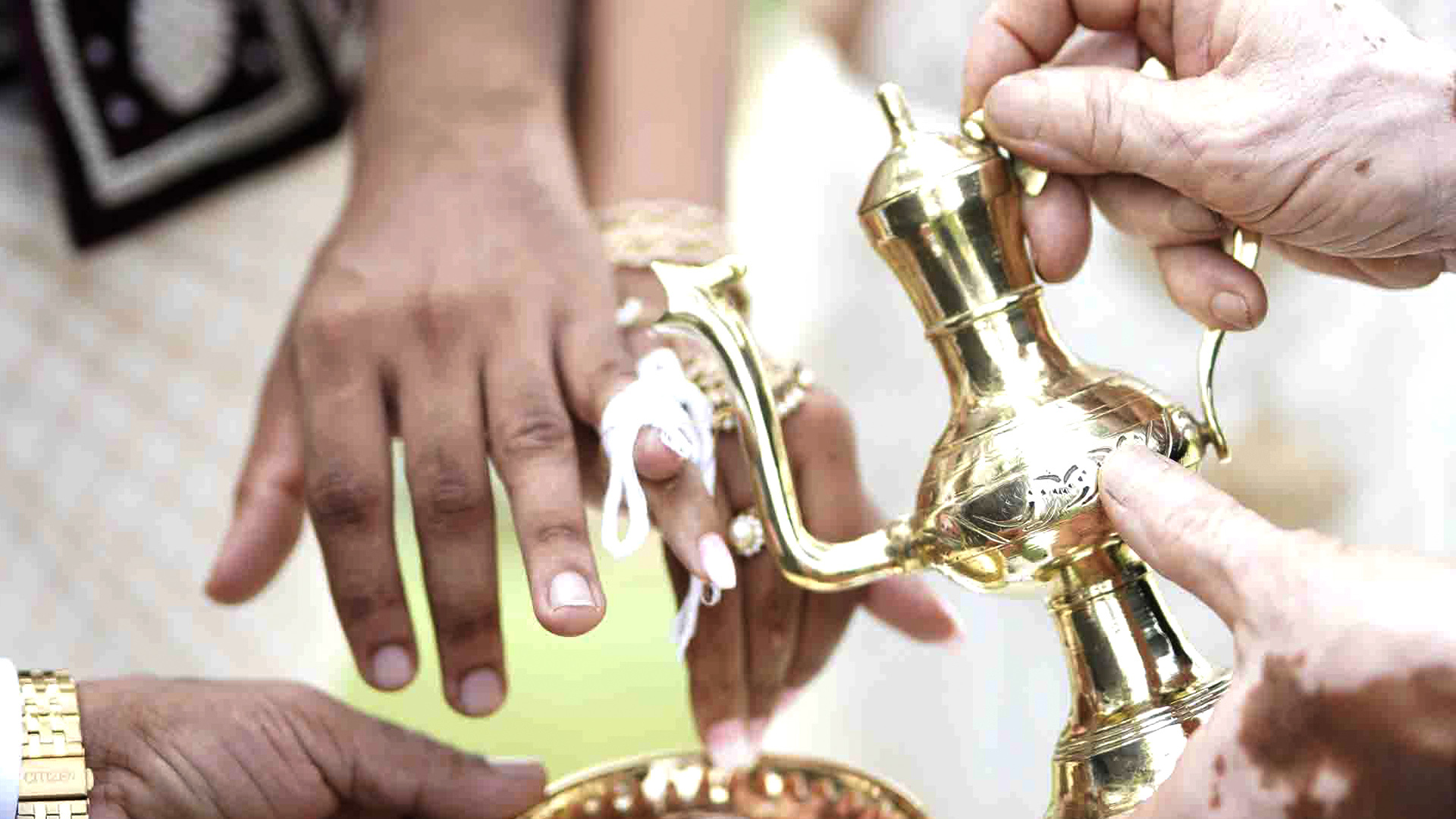

As we mentioned in the last article, if both parties agree on the marriage, the next task is to prepare the auspicious timings (නැකැත්) for the marriage. Generally, creating an auspicious timing for the marriage belongs to the groom’s party. However, despite appearing to be a simple matter, preparing marriage auspicious timing (නැකැත්) is an essential aspect of Sri Lankan matrimony, ensuring harmony and success in the Mangala yojana, Mangala kinkini, or Mangala danweem.
The process begins with both horoscopes of the couple being provided to an astrologer, who determines the most suitable date for the marriage. Wedding auspicious dates are typically chosen based on their compatibility with both horoscopes. Since matchmaking (පොරොන්දම්) and horoscopes (කේන්දර) play a pivotal role in Sri Lankan matrimony, the auspicious timings (විවාහ නැකත්) and wedding date must align with both parties’ birth signs.
In addition, the astrologer considers factors such as whether the wedding ceremony is held at home or in a hall, the distance and travel time between the groom’s and bride’s locations, and the time required for both the bride and groom to prepare. Furthermore, the astrologer also accounts for whether the Poruwa ceremony is performed, as some weddings in Sri Lankan matrimony may only include marriage registration and ring exchange without the traditional rituals.
These auspicious timings (විවාහ නැකත්) are categorized into the pre-wedding, wedding day, and post-wedding auspicious timings in a traditional marriage proposal in Sri Lanka. These timings hold a significant place in Sri Lankan matrimony, as they add layers of meaning and tradition to the event.
Pre-Wedding Auspicious Timings: These include “handing over the auspicious sheet (නැකැත් පත්රය)” prepared by the groom’s family to the bride’s side, inviting relatives to the wedding day, and placing oil pots on the stove (තෙල් වළං ලිප තැබීම), an integral ritual in mangala yojana.
Wedding Day Auspicious Timings: These involve key moments such as “the groom leaving the house,” “tying the headgear (තැල්ල) and veil,” “arrival of the groom,” “rituals on the wedding platform,” “stepping down from the platform,” “marriage registration,” “wedding hall setup,” and “departure of the couple.” All these rituals highlight the cultural richness of Sri Lankan matrimony.
Post-Wedding Auspicious Timings: Events such as “homecoming” and “the newlywed couple entering their house” are cherished moments for every Sri Lankan bride, symbolizing the start of their new life while adhering to the traditions of Mangala sewaya, Mangal kinkini, Mangala yojana, or Mangala danweem.
The groom’s family prepares and hands over the auspicious timing sheet (නැකැත් පත්රය) to the bride’s side. If there are any defects, the bride’s family ensures everything aligns with the values of Sri Lankan matrimony and mangala yojana principles.
While selecting a date might seem straightforward, creating auspicious timings requires a comprehensive understanding of the couple’s horoscopes, ceremony details, and logistical considerations. This meticulous process, guided by an astrologer, ensures a harmonious wedding and a blessed union—hallmarks of Sri Lankan matrimony.
For those seeking a compatible partner to embark on this journey, Poruwa.lk provides a secure platform to connect with potential soulmates. Whether you’re preparing for a marriage proposal in Sri Lanka or embracing the traditions of Mangala yojana, Mangala kinkini, Mangala sewaya, or Mangala danweem Poruwa.lk simplifies the process of finding a partner in Sri Lankan matrimony.
Poruwa.lk is the best platform for Sri Lankan matrimony, helping brides and grooms find love while preserving cultural values. From matchmaking to creating auspicious timings, Poruwa.lk is your trusted partner for a meaningful and fulfilling marriage journey in Sri Lankan matrimony.

 By
By


Keep this going please, great job!
Thank you for your appreciation.
Excellent post. I used to be checking continuously this blog and I’m inspired!
Very helpful info 🙂 I maintain such info a lot.
I was seeking this certain information for a long time.
Thanks and best of luck.
Thank you so much for your kind words and support! 😊
I’m really happy to hear that you found the information helpful. Your feedback truly means a lot and motivates us to keep sharing useful content.
Thanks again for taking the time to leave such a wonderful comment. Wishing you all the very best too!
I just like the helpful information you provide for your
articles. I will bookmark your blog and take a look at again here frequently.
I am rather sure I’ll be informed plenty of new stuff
right here! Best of luck for the next!
Thank you for your appreciation!
Why users still use to read news papers when in this technological world the whole thing is existing on web?
Yes, that’s right, really grateful for your appreciation, it keeps us going.
Hey! I’m at work browsing your blog from my new iphone 4!
Just wanted to say I love reading through your blog and look forward to
all your posts! Keep up the excellent work!
Thank you for your appreciation
I think the admin of this web site is in fact working hard for his web page, since here
every information is quality based data.
Thank you for your appreciation
My brother recommended I might like this website. He was totally right.
This post actually made my day. You can not imagine simply how much time I had spent for this information! Thanks!
Thank you so much for your appreciation
Ahaa, its good dialogue concerning this paragraph here
at this blog, I have read all that, so at this time me also commenting here.
Thank you so much for your appreciation